.png?width=50&name=202307%20-%20Jordan%20Headshot%20(colour).png)
Navigating Market Volatility: A Note on Tariffs & Investment Strategy
Whiplash Economics: Why Volatility Still Shocks Us
As I write this article, investment markets are capping off their worst first-quarter performance since 2022, with April 2025 being particularly volatile. At least, that's what the news headlines we see and hear daily are telling us. Let's remember we're in 2025, so the year 2022 wasn't all that long ago — those panic-inducing headlines feel a bit dramatic.
Yes, there certainly has been plenty of volatility this year, and naturally, it's displeasing to see one's portfolio fall in value. But zoom out a little — are you down on a three-year basis? How about a five-year basis? Probably not. But if you are, please reach out to me, as your portfolio definitely needs saving from yourself.
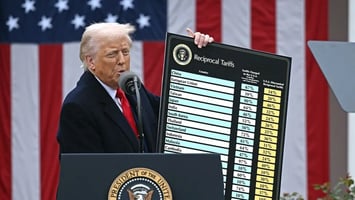
I digress, though. One aspect of the moves we've seen in markets since the start of this year that particularly interests me is how surprised we all seem about the volatility — which, let's be honest, is coming almost entirely off the back of the on-and-off tariffs from President Trump. I mean, he talked about tariffs extensively on the campaign trail, made it clear that this was to be a central part of his entire economic agenda — the guy even referred to tariffs as “the most beautiful word in the dictionary.”
Fortunately I saw a great statistic recently that most Americans don't even know what a tariff is, otherwise I'm sure volatility would be even greater!
We should've seen it coming all along, and yet here we are, flirting with correction — or dare I say it, recession — territory (a decline of 10% or 20%, respectively, in the price of a broad market index from its most recent peak). To be fair to investors, in his first term in office, Trump seemed awfully concerned with the performance of the stock market and often used it to tout the success of his first term.** Throughout** his first presidency, Donald Trump frequently attributed the stock market's performance to his administration's policies and his personal acumen. Here are a couple of my personal favorites:
- November 2017: On Air Force One, he remarked, “The reason our stock market is so successful is because of me. I've always been great with money, I've always been great with jobs — that's what I do. And I've done it well, I've done it really well, much better than people understand, and they understand I've done well.”
- January 2018: He claimed, “Had the opposing party to me won — some of whom you backed, some of the people in the room — instead of being up almost 50 percent — the stock market is up since my election almost 50 percent — rather than that, I believe the stock market from that level, the initial level, would have been down close to 50 percent.”
The above are examples — or rather evidence — of what's commonly referred to as the Trump Put. Effectively, what this means is that because Trump was so concerned with the stock market being a “scorecard” for his performance as President, he would back off on rhetoric that was causing markets to fall and give them some relief. I’ve included a great example of this below (If you'd like to go further and understand what a Put option is, then check out Put Options Explained)
Trade War with China (not to be confused with the current one — I'm referring to the 'first' one in 2018)
-
Trump’s announcement of tariffs on Chinese imports and the escalating trade war caused significant market volatility in 2018. Markets reacted negatively, with fears that tariffs would hurt global trade and economic growth.
-
In response to market declines, Trump would often reassure investors. For example, in 2018, after a significant market sell-off, Trump said, "I think we'll make a deal with China, and I think it will be a very fair deal for everybody, but it will be a good deal for the United States".
The interesting twist is that, in the early days of Trump's second term in the White House, he seems (or at least claims to be) much less concerned with the performance of 'Wall Street' (i.e. the stock market) and more concerned with 'Main Street' (i.e. the broader economy). This brought into doubt whether the Trump Put still existed at all — or whether the threshold for when it would kick in had simply fallen — meaning he would tolerate more pain and volatility in markets before acting.
Fortunately, the Trump Put still seems to be alive and well, as Trump recently backed off somewhat and paused the most extreme tariffs for 90 days. Interestingly, though, it seemed to be weakness in bond markets — not stock markets — that prompted Trump to intervene and calm things down this time around.
I write all this not because I enjoy talking about Trump but more so because we all (professional and retail investors alike) need reminding of our own behavioral biases, emotions and how damaging these can be to your investment portfolio. In today's data-laden and informationally efficient world, sometimes the best thing an investor can do is to zoom out of the hyper-short term news cycle. Headlines are, by their very design, meant to elicit a strong emotional reactions from us which any astute investor knows is the complete antithesis of a rational investment strategy.
It somewhat sickens me that my first article in a while is so focused on politics and less so on the great companies doing incredible things that we and our client's invest in, but the driving force behind today's (and probably tomorrow's) market movements cannot be ignored and should be understood for what it is: short-term noise.
Jordan Toy, CFA